
The textiles ministry is in favour of a reduction in textiles tariffs under ongoing World Trade Organisation negotiations on market access, but said overall reduction in the case of developing countries should be lower than developed countries.

The National Jute Board has developed a jute-viscose blended apparel for Indian athletes participating in the Commonwealth Games 2026 in Glasgow, marking the first time jute-based attire will be featured at an international multi-sport event, promoting sustainable textiles and India's jute industry.

India has strongly refuted claims by the United States Trade Representative (USTR) regarding excess capacity in its steel and textile sectors, arguing that the nation's significantly low per capita consumption of these products contradicts such assertions, according to Amitabh Kumar, Additional Secretary in the Ministry of Commerce.

Guests at President Droupadi Murmu's Independence Day 'At Home' reception will be welcomed with handwoven Maheshwari stoles, celebrating the vibrant art traditions of Chhattisgarh, Goa, Madhya Pradesh, and Maharashtra, alongside an invitation package highlighting sustainable environmental practices.

From guns to handlooms. From forest trails to a public runway. Women who had once been associated with that conflict walked into the spotlight wearing Bastar's traditional textiles.

It is plain to see that the US senate bill's real objective is to derail India's time-tested strategic partnership with Russia, points out Ambassador M K Bhadrakumar.

A Parliamentary Standing Committee on Commerce has urged the Indian government to swiftly conclude the proposed India-US Bilateral Trade Agreement (BTA), while ensuring India's interests are protected, recommending complete exemption for key export products like generic medicines and smartphones from future US tariff increases.
The textile sector will get a major boost in terms of infrastructure in next 100 days with the government opening two integrated textile parks, pumping in additional resources of Rs 1,660 crore (Rs 16.60 billion) for cotton MSP and launching training programmes for 50,000 weavers.

Central tax authorities detected input tax credit (ITC) fraud worth Rs 74,781.56 crore across 30,162 cases in FY26, more than doubling the number of cases from the previous year, according to the Ministry of Finance.

Prime Minister Narendra Modi announced that the India-UK Comprehensive Economic and Trade Agreement (CETA) will come into effect on July 15, 2026, anticipating a significant boost to bilateral trade and investment.

The new area expansion would help in increasing the production of silk from the present 23,000 tonnes per annum to 32,000 tonnes, a growth of 39 per cent.

India's industrial production expanded at a slower pace of 4.9 per cent in April, primarily due to tepid growth in the energy sector amidst the West Asia crisis. This data marks the first release under the newly revised base year of 2022-23 for the Index of Industrial Production (IIP).

Recent BJP organisational moves and Rajya Sabha nominations have sparked speculation that Prime Minister Narendra Modi may soon undertake a ministerial reshuffle.
Ahead of the Budget 2009-10, Textiles Minister Dayanidhi Maran on Friday said efforts will be made to provide fiscal relief, including service tax exemption, to textile exporters reeling under waning global demand.
Making out a case for further rationalisation of duties, Textiles Minister Kashiram Rana Tuesday said his ministry would seek implementation of the N K Singh committee recommendations for the sector in the ensuing Budget.

India's wholesale price inflation surged to 8.30 per cent in April, up from 3.88 per cent in March, primarily driven by a significant increase in the prices of fuel, power, and crude petroleum, according to data from the commerce and industry ministry.

According to an industry expert, companies such as Trident, Welspun India, Arvind, KPR Mill, Vardhman Textiles, Page Industries, Raymond, and Alok Industries stand to gain, as revenue from the US market accounts for 20-60 per cent of their earnings.
American industry groups sought punitive tariffs on Indian goods at USTR hearings, while Indian officials defended the country's manufacturing growth as demand-led and WTO-compliant.

The Indian government has waived customs duty on critical petrochemical products until June 30 to ensure supply stability and provide relief to consumers amid disruptions caused by the crisis in West Asia.

The ministry of petroleum and natural gas on Friday reiterated that India has sufficient stock of crude oil, petrol and diesel, while ensuring an uninterrupted supply of LNG and LPG despite disruptions caused by the ongoing West Asia conflict.

18 Indian-flagged vessels with 485 Indian seafarers still remain in the western Persian Gulf region
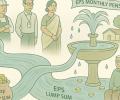
A parliamentary panel has recommended an urgent review of the Rs 1,000 minimum monthly pension under the Employees' Pension Scheme, 1995, to raise it to a more realistic and dignified level, considering the rising cost of living and the financial hardships faced by pensioners.

Wholesale price inflation extended upward momentum for the third straight month, at 1.81 per cent in January, driven by an uptick in prices of food, non-food articles, and manufactured items on a month-on-month basis, government data showed on Monday.
India's wholesale price inflation (WPI) increased for the fourth consecutive month in February, reaching 2.13 per cent, primarily due to rising prices of food and manufactured goods, according to government data.

India has set an ambitious target of textile exports worth $100 billion by 2030, but the recent data released by the Ministry of Textiles pertaining to India's textile and apparel trade puts achievement of the goal in jeopardy.

India's merchandise exports experienced a slight decrease in February, while imports surged due to increased gold and silver purchases, leading to a widened trade deficit. The West Asia crisis is expected to further impact trade in the coming months.
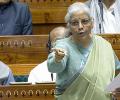
Finance Minister Nirmala Sitharaman launched a strong attack on Rahul Gandhi and the Congress party, accusing them of compromising India's interests on the world stage and selling out farmers and the poor during their time in power.

'The state governments of Gujarat, Maharashtra and Tamil Nadu will be encouraged to consider measures of their own as the employment and economy in such export-oriented states will be affected.'
Under the scheme for integrated textile parks, the government provides up to 40 per cent of the cost of setting up a textile park with a ceiling of Rs 40 crore (Rs 400 million). Till now the ministry has contributed Rs 450 crore (Rs 4.5 billion). The industry has pitched in with nearly double this amount.
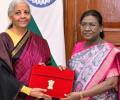
Union Finance Minister Nirmala Sitharaman is well-known for donning saris that speak as powerfully as her budget speech. Each Budget Day, she selects a drape that pays tribute to India's amazing textile heritage and the mastery of its artisans.

Capex, infrastructure development, and prudent fiscal management are the key focus areas in the Budget, says Nilesh Shah.
This comes in the background of claims by the Confederation of Indian Textile Industry, an industry body, that about 700,000 jobs have been cut in the last six months. The industry lobby group has also forecast a further loss of half a million jobs in the next five months.
The country's exports rose marginally by 0.61 per cent to $36.56 billion in January, while trade deficit widened to a three-month high of $34.68 billion, government data showed on Monday.
Wholesale price inflation extended upward momentum for the second straight month, recording at 0.83 per cent in December 2025, driven by an uptick in prices of food, non-food articles, and manufactured items on a month-on-month basis, government data showed on Wednesday. Wholesale Price Index (WPI)-based inflation returned to positive in December, after witnessing a deflationary trend in the previous two months.

Prime Minister Narendra Modi on Tuesday announced the signing of the India-EU Free Trade Agreement (FTA), saying it accounts for 25 per cent of global GDP and one-third of global trade.

Following a Supreme Court setback, Donald Trump has announced an increase in global tariffs from 10% to 15%, impacting international trade relations and raising concerns about economic repercussions.

Pratibha Pawar, wife of NCP (SP) chief Sharad Pawar, was allegedly stopped from entering the premises of Baramati Hi-Tech Textiles Park in Pune district on Sunday for half an hour. This was informed by the office of Baramati MP Supriya Sule. Notably, Deputy Chief Minister Ajit Pawar's wife and Rajya Sabha member Sunetra Pawar is the chairperson of the Baramati Hi-Tech Textiles Park. A video shared by Supriya Sule's office shows female aides of Pratibha Pawar and Sule's daughter Revti Sule asking a security guard at the Park to open the gate as they wanted to do some purchasing. The guard told them he was instructed by one Anil Wagh to not open the gate. A male aide accompanying Pratibha Pawar and Revti Sule confirmed to PTI that they were not allowed to enter the premises for at least 30 minutes. When contacted, Textile Park chief manager Anil Wagh said he was not aware that Pratibha Pawar was supposed to visit the premises. He claimed he instructed security personnel to not allow any political rally inside. When he was told that Pratibha Pawar had arrived, he immediately asked security guards to open the gate and allow them inside. According to Wagh, Pratibha Pawar and Revti Sule visited some companies on the premises of the Park and interacted with women workers. Baramati Hi-Tech Textile Park is one of 26 parks approved by the Union Ministry of Textiles. Under the chairmanship of Sunetra Pawar, this park was set up in the year 2008 over an area of 65 acres in Baramati in Pune district. A fierce electoral battle is playing out in the Baramati assembly constituency between Ajit Pawar, who revolted against uncle Sharad Pawar last year, and his nephew Yugendra Pawar.

New Delhi will substantially reduce tariffs on industrial and agricultural goods while continuing to protect sensitive sectors. Tariffs on some agricultural products that are not traditionally considered sensitive will be brought down to zero, while in the case of relatively sensitive items, duties will be reduced in a graded manner and quotas will be imposed.
